 Автор player

Trading conditions can determine whether a proprietary trading program is a practical fit for your strategy or an unnecessarily difficult challenge. Two firms may advertise similar account sizes but impose very different daily loss limits, maximum drawdowns, payout restrictions, and evaluation requirements.
For traders comparing prop firms, the most useful approach is to look beyond promotional offers. A low entry fee has limited value if the drawdown rules are incompatible with your strategy. Similarly, a high profit split may be less attractive if payout eligibility depends on restrictive consistency requirements or account-specific conditions.
This guide compares ten proprietary trading firms based on their published program structures, risk management rules, evaluation processes, and payout arrangements. It includes both CFD-oriented and futures-focused providers because the right choice depends on the markets you trade.
Top 10 prop firms ranked by trading conditions
| Rank | Prop Firm | Best For | Main Trading Conditions to Evaluate | Potential Limitation |
|---|---|---|---|---|
| 1 | FTMO | CFD traders seeking clearly documented evaluation rules | Defined profit targets, daily and maximum loss limits, multiple account models | Different models use different drawdown calculations |
| 2 | Topstep | Futures traders who prefer a structured funding pathway | Contract limits, Maximum Loss Limit, scaling and payout rules | Trailing drawdown and payout conditions require careful planning |
| 3 | The5ers | CFD traders comparing different evaluation paths | Multiple programs, risk limits and progression options | Payout caps and consistency rules depend on the program |
| 4 | FundedNext | Traders comparing several CFD challenge models | Different targets, loss thresholds and evaluation formats | Rules vary considerably by account type |
| 5 | Leofins | CFD traders looking for multiple challenge structures | Core 2-Step, Edge 1-Step and Starter 3-Step programs | Each model has different risk and reward conditions |
| 6 | FundingPips | CFD traders who want several evaluation formats | Multiple combinations of profit targets and loss limits | The chosen model determines the applicable restrictions |
| 7 | TradeDay | Futures traders comparing evaluation and funded-sim pathways | Futures-specific risk rules and progression options | Account type affects scaling and payout eligibility |
| 8 | MyFundedFutures | Futures traders comparing plan-specific rules | Contract allowances, end-of-day drawdown and evaluation targets | Parameters differ between plans |
| 9 | Apex Trader Funding | Futures traders who understand balance-based progression | Contract tiers, drawdown and account-specific payout rules | Scaling and withdrawal requirements need close attention |
| 10 | Earn2Trade | Futures traders who prefer structured evaluations | Position progression, daily loss rules and consistency requirements | Multiple risk conditions must be satisfied together |
This is an editorial ranking based on the usefulness and structure of published trading conditions, not a guarantee of results. It is not a claim that every firm offers the same markets or that one account’s rules apply across an entire company.
What makes trading conditions genuinely competitive?
Before examining each provider, it helps to establish which rules have the greatest practical impact.
Daily loss limits
A daily loss limit defines how much an account can lose within a trading day before a restriction or breach occurs. The calculation may include open-position losses, commissions, swaps, or other charges.
The reference point matters just as much as the percentage. One program might calculate the limit using the initial account balance, while another uses a daily starting balance or equity reference.
Traders should establish when the daily limit resets and whether reaching it pauses trading or terminates the account. Those outcomes are not interchangeable.
Maximum drawdown
The maximum loss rule defines the overall loss threshold that an account must not breach.
A static drawdown remains anchored to a defined starting balance. A trailing drawdown moves according to a specified balance or equity reference as the account develops. Some futures programs use end-of-day calculations, while others can apply different conditions at other stages.
A trailing threshold can become more restrictive after profitable periods. This is especially important for strategies that allow profits to fluctuate substantially before positions are closed.
Evaluation targets and minimum trading requirements
Some challenges require one evaluation phase; others use two or more. A program may also require a minimum number of trading days or impose a consistency rule that limits the contribution of a single profitable day.
The target should be assessed alongside the risk limits. A high target combined with a tight drawdown can require a very different trading approach from a lower target with more room for normal fluctuations.
Payout rules
Passing an evaluation does not necessarily mean that a trader can immediately withdraw any amount of profit.
Firms may set minimum profit requirements, winning-day conditions, payout caps, withdrawal intervals, or consistency criteria. Some also distinguish between simulated funded accounts and live accounts.
Review the entire payout policy before buying a challenge. A firm’s headline profit split does not tell you when you can withdraw or how much is eligible.
1. FTMO: Clearly defined rules across multiple CFD models
FTMO ranks first because its published trading objectives provide a structured basis for comparing the main evaluation and funded-account conditions.
The firm offers a two-step challenge, a one-step challenge, and an Instant model. Each has different requirements, so traders must select the model that matches their risk tolerance and preferred evaluation process.
For the published two-step challenge, the profit targets are 10% in Phase 1 and 5% in Phase 2. The maximum daily loss is 5%, and the maximum loss is 10% of the initial simulated capital. The evaluation also requires at least four trading days.
The one-step model uses different calculations. Its published objectives include a 10% target, a 3% maximum daily loss, and a 10% maximum-loss limit that trails according to the firm’s rules. A consistency requirement also applies to the relevant one-step accounts.
Why it ranks highly: FTMO provides clearly separated program models and detailed explanations of how key loss thresholds are calculated.
What to watch: Do not assume the two-step rules apply to the one-step or Instant model. Compare the drawdown calculation, consistency requirements, minimum trading days, and reward conditions for the exact account you intend to purchase.
FTMO is particularly relevant to CFD traders who value documented rules and want to understand their obligations before starting an evaluation.
2. Topstep: A futures-focused program with defined risk parameters
Topstep is designed for traders who specialize in exchange-traded futures. Its Trading Combine evaluates a trader in a simulated environment before they can qualify for an Express Funded Account and potentially progress toward a Live Funded Account.
The Trading Combine has a profit target, a consistency objective, and a Maximum Loss Limit. The published maximum position sizes are five contracts for the $50,000 account, ten for the $100,000 account, and fifteen for the $150,000 account. Micro contracts count at a 10:1 ratio under the applicable rules.
The Maximum Loss Limit is a trailing threshold. For the standard account sizes listed in Topstep’s current help documentation, it starts $2,000 below the balance on a $50,000 account, $3,000 below on a $100,000 account, and $4,500 below on a $150,000 account. It rises as the end-of-day balance increases and locks at the starting balance.
Payout eligibility depends on the funded-account path. For example, Topstep’s published Express Funded Account Standard policy requires five winning days with at least $150 in net profit each, while the Consistency path uses different requirements. Both paths have payout caps and other conditions.
Why it ranks highly: The program provides explicit contract limits and a defined progression pathway.
What to watch: Futures traders must understand contract values, the trailing loss threshold, scaling requirements, and payout eligibility. These conditions differ from percentage-based CFD challenges, so the account size alone should not determine your choice.
3. The5ers: Multiple evaluation structures for CFD traders
The5ers offers several CFD-oriented programs with different evaluation targets, drawdown rules, and progression conditions.
Its published two-step plan includes New and Classic options. The New version uses a 10% Phase 1 target followed by 5% in Phase 2, while the Classic version uses 8% and 5%. Both use a 10% maximum-loss limit and a daily loss limit of 3% of the previous day’s closing balance or equity, whichever is higher.
The funded stage introduces additional conditions. For the two-step program, the firm publishes a 50% consistency requirement on the funded account and a payout cap of $2,000 per cycle for the $100,000 plan. The minimum profit required to request a payout is $250.
Other The5ers programs have different rules, including different loss thresholds and progression structures. That variety makes it important to compare the exact program rather than relying on a single general description.
Why it ranks highly: Traders can compare different evaluation paths instead of being limited to one universal challenge.
What to watch: Check the program’s payout cap, consistency rule, daily loss reference, and maximum-loss calculation. A favorable evaluation structure may still be unsuitable if its funded-account conditions conflict with your trading style.
4. FundedNext: Different CFD models for different strategies
FundedNext offers several evaluation structures with distinct profit targets, daily loss limits, maximum-loss thresholds, and minimum trading requirements.
Its published CFD challenge terms distinguish between the Evaluation, Express, Stellar 1-Step, Stellar 2-Step, and Stellar Lite models. For example, the Stellar 1-Step uses a 10% profit target, a 3% daily loss limit, and a 6% maximum-loss limit. The Stellar 2-Step uses targets of 8% and 5%, a 5% daily loss limit, and a 10% maximum-loss limit. Stellar Lite uses targets of 8% and 4%, with a 4% daily loss limit and an 8% maximum-loss limit.
These differences can be useful when a trader wants to compare a single-stage evaluation with a multi-stage alternative. However, the lowest daily loss percentage or the smallest number of evaluation phases does not automatically make a program better.
Why it ranks highly: Multiple models provide a range of conditions to compare.
What to watch: Identify the exact model, then examine the target, loss calculation, minimum trading days, prohibited trading practices, and reward eligibility. Add-ons and special offers may change the applicable parameters, so the checkout terms also matter.
5. Leofins: Three CFD challenge structures to compare
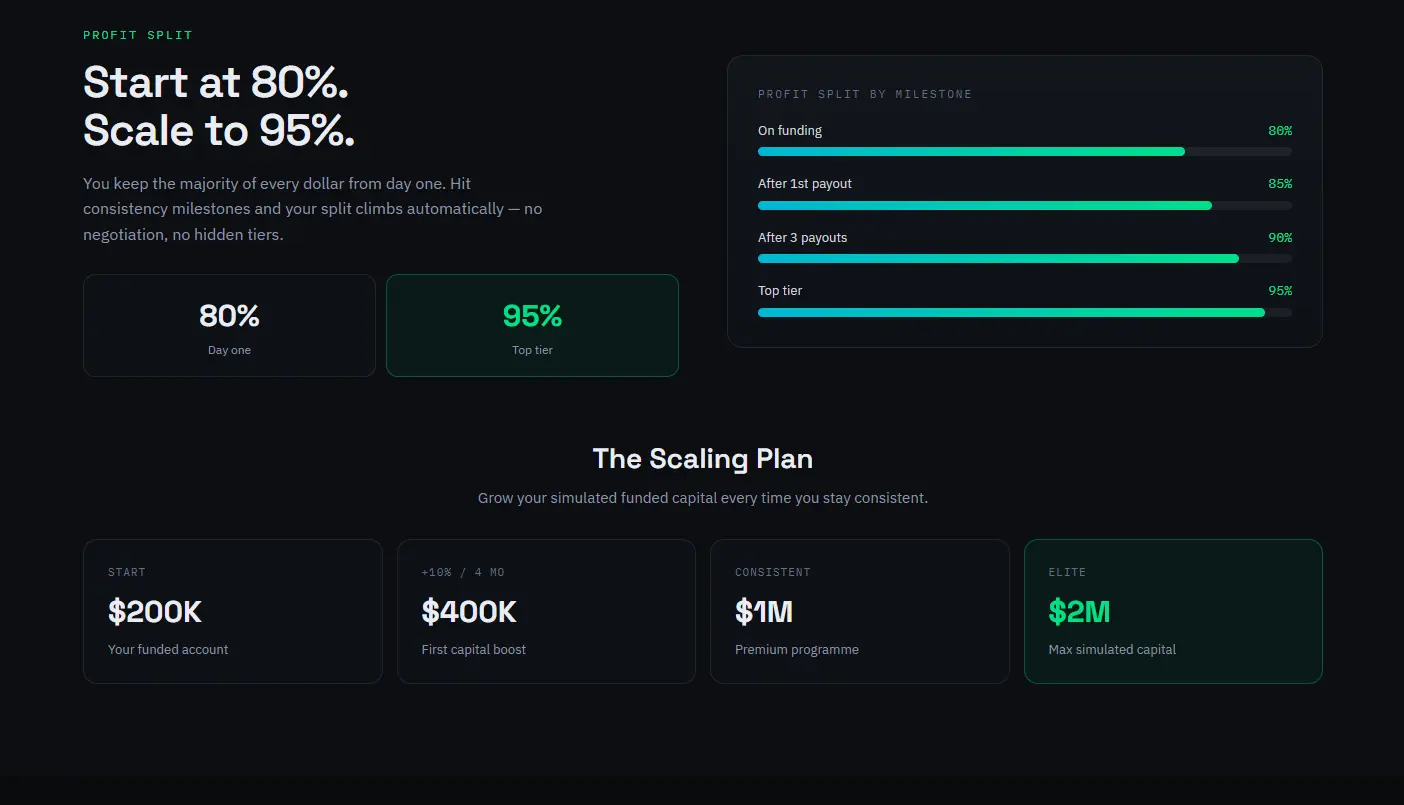 Leofins ranks fifth because it offers several challenge formats with different profit targets and risk parameters, allowing traders to compare the structure that best matches their approach.
You can review the programs at www.leofins.com
The firm’s published options include Core 2-Step, Edge 1-Step, and Starter 3-Step. Their headline risk parameters differ:
- Core 2-Step: Targets of 7% and 4% across two phases, a 5% daily loss limit, and a 10% static maximum loss.
- Edge 1-Step: An 8% target, a 4% daily loss limit, and a 7% static maximum loss.
- Starter 3-Step: Targets of 6%, 4%, and 4% across three phases, a 4% daily loss limit, and an 8% static maximum loss.
These are program-specific parameters; traders should verify the current terms before paying.
Why the drawdown structure matters
A static maximum-loss threshold stays anchored to the initial balance rather than moving upward as the account achieves new highs. This can make the overall loss boundary easier to calculate when planning position sizes.
The daily loss limit still applies, however, and traders must understand the reference used for the daily calculation. A static overall threshold does not mean an account can withstand unlimited intraday losses.
Leofins’ three challenge formats also differ in the number of phases required to qualify. Traders should consider whether they prefer one evaluation stage, two stages, or a more gradual three-stage process.
Why it ranks here: The variety of challenge structures gives CFD traders specific alternatives to compare rather than forcing every trader into one format.
What to watch: Review payout eligibility, consistency requirements, trading restrictions, and the rules for the exact account. The best fit depends on the full set of conditions, not just the maximum-loss percentage.
6. FundingPips: Several models with distinct risk limits
FundingPips offers multiple CFD evaluation and funded-account models. Its published comparison distinguishes between 1 Step Flex, 2 Step Standard, 2 Step Pro, 2 Step Flex, and Zero Instant Master.
For example, the 2 Step Standard model uses an 8% target in Phase 1 and 5% in Phase 2, with a 10% static overall loss limit. The 2 Step Pro uses a 6% target in each phase, a 3% daily loss limit, and a 6% static maximum-loss limit. Other models use different parameters.
The reward structure also depends on the model. FundingPips publishes different weekly, biweekly, and on-demand reward arrangements, with percentages that vary by account type and selected options.
Why it ranks here: Traders can compare different evaluation structures and risk profiles under one provider.
What to watch: Do not mix rules from separate models. Confirm the daily loss threshold, overall drawdown, minimum trading days, overnight and weekend holding conditions, and reward schedule for the specific account.
7. TradeDay: Futures evaluations with account-specific rules
TradeDay is a futures-focused option for traders who want to compare evaluation and funded-simulated pathways.
Its account structures have different position limits, drawdown calculations, and progression conditions. For traders comparing futures firms, the most important task is to establish whether the chosen account uses an end-of-day or intraday trailing threshold and how the firm enforces that limit.
TradeDay’s published Fast Pass funded-sim pathway links increases in contract allowance to end-of-day profit. The stated rule adds one contract for every $2,000 of end-of-day profit, subject to the applicable program terms.
Why it ranks here: Its futures-specific progression structure is relevant to traders who want to build position size as account performance develops.
What to watch: Verify the current account type, starting contract limit, drawdown calculation, payout requirements, and any conditions governing a transition to live funding. Do not assume that every TradeDay product uses the same rules.
8. MyFundedFutures: Compare the exact futures plan
MyFundedFutures offers multiple futures plans, so the relevant trading conditions depend on which account a trader selects.
Its published Pro Plan evaluation parameters list profit targets of $3,000 for the $50,000 tier, $6,000 for the $100,000 tier, and $9,000 for the $150,000 tier. The associated end-of-day Maximum Loss Limits are $2,000, $3,000, and $4,500 respectively. The listed maximum position sizes are three, six, and nine mini contracts.
Other plans use different targets, position limits, and consistency requirements. A trader should therefore avoid applying Pro Plan rules to another MyFundedFutures account.
Why it ranks here: The plan-specific parameters make it possible to compare futures account structures using concrete targets and position limits.
What to watch: Review the exact plan’s maximum loss, consistency objective, minimum trading days, payout conditions, and restrictions on holding positions during news. These details may affect a strategy more than the advertised account size.
9. Apex Trader Funding: Contract tiers and account-specific restrictions
Apex Trader Funding is another futures-focused firm to investigate when comparing trading conditions.
Its evaluation and funded-account structures use contract limits and risk rules that depend on the selected account and stage. The maximum number of permitted contracts is only one part of the decision: traders must also understand the relevant drawdown threshold and the conditions governing withdrawals.
Futures accounts can have different risk profiles even when their displayed starting balances are similar. A trader who trades close to the maximum contract allowance may be more sensitive to adverse price movements than someone who uses a smaller position size.
Why it ranks here: Apex is relevant to futures traders comparing contract-based programs and balance-dependent account progression.
What to watch: Confirm the current evaluation rules, contract tiers, drawdown calculation, payout eligibility, and any scaling requirements directly in the applicable rulebook. Do not rely on an old comparison chart when the firm has updated its account structures.
10. Earn2Trade: Structured futures evaluations
Earn2Trade rounds out the comparison for traders who want a futures evaluation with explicit performance and risk requirements.
The firm’s Trader Career Path and Gauntlet Mini programs require traders to respect the daily loss limit, maximum position size, minimum account balance, approved trading hours, and consistency rules. Its published evaluation guidance also states that there is no fixed minimum number of trading days, although the consistency rule can mean that several profitable days are necessary in practice.
The maximum position size is especially important because the progression ladder is a hard rule. Reaching a profit target does not compensate for exceeding the permitted contract limit.
Why it ranks here: Its structured evaluation requirements are useful for traders who prefer clearly defined performance and position-size conditions.
What to watch: Check the current profit target, daily loss threshold, end-of-day drawdown, consistency requirement, approved trading hours, and maximum position size for the exact program.
How to choose the best trading conditions for your strategy
A prop firm’s rules should be compatible with the way you trade. The following checks can help narrow the shortlist.
If you trade forex or CFDs
Start by comparing daily loss and maximum loss rules. Establish whether the daily reference uses the initial balance, the day’s starting balance, or a balance/equity calculation. Then check the target, minimum trading days, and consistency requirements.
FTMO, The5ers, Leofins, FundedNext, and FundingPips all have multiple program structures or model-specific conditions. The appropriate choice depends on which exact set of rules suits your strategy.
If you trade futures
Prioritize the contract specifications, maximum position size, and drawdown method. A trailing loss limit can behave differently from a static threshold, and contract size directly affects the financial impact of each tick.
Topstep, TradeDay, MyFundedFutures, Apex Trader Funding, and Earn2Trade should be compared using the rules of the specific futures account rather than by converting their account sizes into CFD-style percentages.
If payouts are your main concern
Read the payout policy before paying for a challenge. Check the minimum profit required, winning-day requirements, payout caps, consistency rules, and whether withdrawals affect the account’s drawdown or scaling status.
A large advertised profit split does not automatically mean that funds can be withdrawn immediately or without restrictions.
If you want the simplest rules
Prioritize transparency. A rulebook should explain how losses are calculated, when thresholds reset, what counts as a breach, and what happens after a successful evaluation.
If a critical condition is unclear, ask the firm for clarification before purchasing. Avoid building a trading plan around assumptions about how a rule will be interpreted.
Frequently asked questions
What are the most important trading conditions at a prop firm?
The main conditions are daily loss, maximum drawdown, profit targets, position limits, minimum trading requirements, payout eligibility, and prohibited trading practices. These determine how much flexibility a trader has and what can lead to an account breach.
Is a static drawdown better than a trailing drawdown?
Neither is universally better. A static threshold remains anchored to a defined starting balance, while a trailing threshold changes according to the firm’s calculation. A static limit may be easier to plan around, but the overall value depends on the other rules and the trader’s strategy.
Which prop firm has the easiest challenge?
There is no universal answer. A lower target may be offset by a tighter drawdown, a stricter consistency requirement, or a more restrictive payout policy. Compare the complete set of conditions rather than judging a challenge by one number.
Are futures and CFD account sizes comparable?
Not directly. Futures programs commonly specify contract limits and futures-specific loss rules, while CFD programs often use percentage-based daily and maximum loss limits. The displayed balance does not establish equivalent market exposure.
Does passing a challenge guarantee payouts?
No. Passing an evaluation establishes eligibility for the next stage under the firm’s rules. Payouts may still depend on funded-account performance, withdrawal conditions, consistency requirements, verification, and compliance with the agreement.
Should I choose a firm based on its profit split?
The profit split matters, but it should not be the only deciding factor. A favorable split is less useful if the drawdown limits, trading restrictions, or payout conditions are incompatible with your strategy.
Final recommendation: Compare rules before account size
The best prop firm is the one whose conditions fit your market, risk tolerance, and trading process. FTMO offers a structured CFD evaluation framework; Topstep is a futures-focused option with defined contract limits and a staged funding pathway; and The5ers, FundedNext, Leofins, and FundingPips provide CFD models with different evaluation and risk structures.
For futures traders, TradeDay, MyFundedFutures, Apex Trader Funding, and Earn2Trade are worth comparing through their current contract limits, drawdown calculations, and funded-account requirements.
Before making a purchase, read the current rules for the exact program. Calculate how much room your strategy needs, establish when a breach occurs, and understand the conditions for withdrawing profits. A well-matched program should support disciplined trading rather than encourage unnecessary risk.
Prices and conditions are current as of October 2026.
Risk disclaimer: Proprietary trading evaluations involve financial risk. Challenge fees may be lost if an evaluation is unsuccessful or program rules are breached. Simulated trading and funded-program results do not guarantee future performance or income. Review the current terms carefully and never spend money you cannot afford to lose.